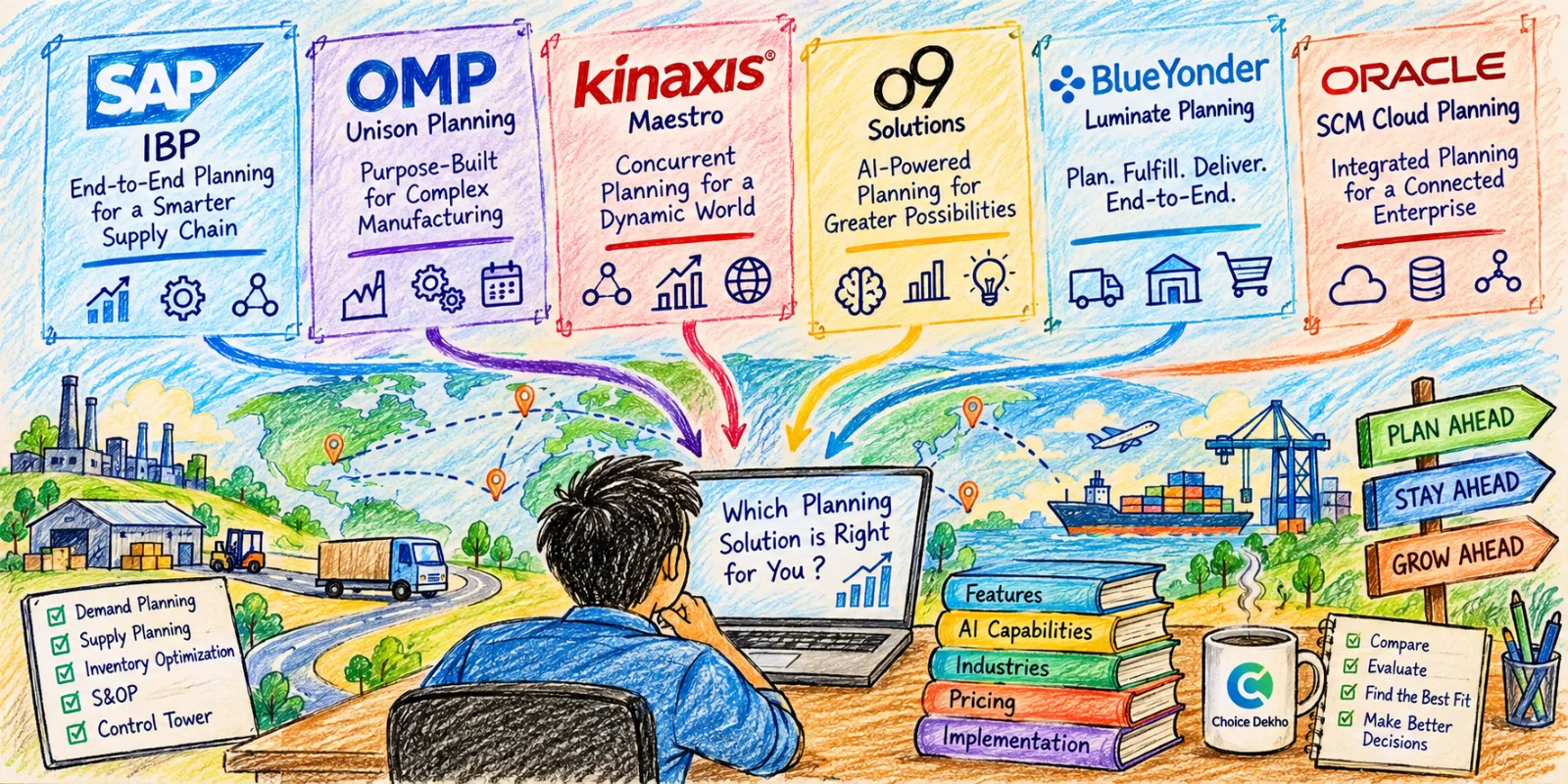
Who should read this article?
This guide is for:
Supply Chain Consultants (SAP IBP , OMP , Kinaxis ,o9 , Blue Yonder , Oracle SCM Cloud Planning)
Supply Chain Architects
Planning Managers.
Digital Supply Chain Leaders.
Students learning SAP IBP.
Which Supply Chain Planning tool is best ?
Every Supply Chain customer is asking the same question. Should we migrate to SAP IBP, move to OMP, adopt Kinaxis Maestro, implement o9 Solutions, choose Blue Yonder, or stay within Oracle SCM Cloud Planning?
The answer isn't as simple as choosing the platform with the most AI features.
After working on SAP APO and SAP IBP transformations across manufacturing, healthcare, electronics, and consumer goods organizations, I've learned that supply chain planning platforms succeed or fail based on architecture, master data quality, ERP integration, planning maturity, and business processes—not marketing brochures.
This guide compares six enterprise planning platforms from an architect's perspective.
Quick Comparison Snapshot
Platform | Best For | ERP Fit |
SAP IBP | SAP S/4HANA ERP | SAP Ecosystem |
OMP | Complex Manufacturing | Multi ERP |
Kinaxis | Concurrent Planning | Multi ERP |
o9 | AI Decision Intelligence | Multi ERP |
Blue Yonder | Retail + Logistics | Multi ERP |
Oracle SCM | Oracle ERP Planning | Oracle Fusion ERP |
Table of Contents for this Tutelage
How Modern Supply Chain Works
What is Supply Chain Planning Software?
SAP IBP overview , Strength & Limitations.
OMP overview , Strength & Limitations.
Kinaxis overview , Strength & Limitations.
o9 overview , Strength & Limitations.
Blue Yonder overview , Strength & Limitations.
Oracle SCM overview , Strength & Limitations.
Features Comparison
Industry Comparison
AI Capability Comparison
Verdict- Which tool should you choose
FAQ.
How Modern Supply Chain Works ?
Modern supply chain planning is a connected decision-making journey that starts with understanding market demand and ends with delivering products to customers. Instead of planning everything at once, organizations divide planning into four layers—Strategic, Tactical, Operational, and Execution—with each layer answering different business questions and operating on a different time horizon.
The End-to-End Supply Chain Planning Journey
Supply chain planning begins with market signals such as customer demand, sales trends, seasonality, promotions, and economic conditions. These inputs help organizations forecast future demand and align business strategy.
Planning then moves through four interconnected stages:
Planning Layer | Typical Time Horizon | Purpose |
Strategic Planning | 12–36 Months | Defines long-term business strategy, network design, capacity investments, and executive Sales & Operations Planning (S&OP). |
Tactical Planning | 3–18 Months | Creates balanced demand, supply, inventory, and capacity plans to meet future business requirements. |
Operational Planning | 1 Day – 12 Weeks | Converts tactical plans into executable production, procurement, allocation, and order planning decisions. |
Execution Planning | Real-Time / Daily | Executes purchase orders, production orders, warehouse activities, transportation, and customer fulfillment. |
What Happens at Each Planning Stage?
1. Strategic Planning – Setting the Direction
Strategic planning focuses on long-term decisions that shape the supply chain over multiple years. Organizations decide which markets to serve, how the supply network should be designed, where factories or warehouses should be located, and how much production capacity should be invested.
The outcome is a business-aligned supply chain strategy that supports long-term growth.
2. Tactical Planning – Creating a Feasible Plan
Tactical planning translates strategy into medium-term plans. It determines expected demand, available supply, inventory targets, and capacity requirements over the coming months.
The goal is to balance demand and supply while maintaining service levels and controlling inventory costs.
3. Operational Planning – Planning in Detail
Operational planning works at a much shorter horizon and focuses on execution-ready decisions. It determines which customer orders should be fulfilled, how constrained supply should be allocated, what production orders need to be created, and what materials should be procured.
The result is a detailed, executable supply plan.
4. Execution Planning – Turning Plans into Action
Execution planning is where planning becomes reality. Production orders are released, purchase orders are created, warehouse operations begin, transportation is scheduled, and products are delivered to customers.
This layer ensures the organization fulfills customer demand on time and at the required service level.
Why These Planning Layers Are Connected
The four planning layers are not independent systems. Decisions made at one level directly influence the next.
Strategic decisions determine future capacity and network design.
Tactical plans balance demand and supply over the medium term.
Operational planning converts those plans into daily production and procurement decisions.
Execution confirms whether the plan is actually delivered to customers.
A change in customer demand or supply constraints can flow through every planning layer, requiring updated plans across the supply chain.
What is Supply Chain Planning Software?
Supply Chain Planning software helps organizations answer questions like:
Business Question | Planning Capability |
What will customers buy? | Demand Planning |
How much inventory is needed? | Inventory Optimization |
Where should products be produced? | Supply Planning |
Which supplier should fulfill demand? | Response & Supply Planning |
What happens if demand increases by 20%? | Scenario Planning |
Can production meet constrained demand? | Finite Capacity Planning |
What is SAP IBP?
SAP IBP is part of SAP's Digital Supply Chain portfolio alongside SAP S/4HANA, SAP EWM, SAP TM, SAP PPDS, SAP Ariba, and SAP BTP.
Learn more → SAP Overview
Learn SAP IBP from beginner to architect.
SAP IBP Modules
Module | Purpose |
S&OP | Executive planning and financial integration. |
Demand Planning | Statistical forecasting, ML forecasting, demand sensing |
Supply Planning | Finite and unconstrained supply planning. |
Response & Supply | Order-based planning |
Inventory Optimization | Multi-echelon inventory optimization. |
Control Tower | Supply chain visibility and alerts. |
Best Industries
Electronics
Consumer Goods
Healthcare
Manufacturing
Automotive
Industrial Equipment
SAP IBP Strengths
Native SAP integration.
Real-time S/4HANA connectivity.
Planner Workspace.
Strong inventory optimization.
Extensive SAP ecosystem.
SAP IBP Limitations
High implementation effort.
Memory-intensive planning areas.
OMP Planning Overview
OMP Planning is an AI-driven supply chain planning platform especially strong in process manufacturing.
It combines:
Demand Planning.
Supply Planning.
Detailed Scheduling.
Inventory Planning.
S&OP.
AI orchestration.
OMP has consistently been recognized as a Leader in Gartner's Supply Chain Planning evaluations for process industries.
Industries
Chemicals
Pharma
Food & Beverage
Paper
Metals
Consumer Goods
Strengths
Finite capacity planning.
Constraint modeling.
Scheduling.
AI orchestration.
Decision-centric planning.
Limitations
Higher consulting dependency.
Smaller talent pool.
Learning curve.
Kinaxis Overview
Kinaxis specializes in Concurrent Planning. Instead of sequential planning:
Demand → Supply → Inventory
Kinaxis updates everything simultaneously.
Best Industries
Aerospace
Semiconductor
Electronics
Automotive
Strengths
Scenario planning.
Real-time propagation.
Supply-demand synchronization.
Semiconductor and high-tech industries.
Limitations
Higher implementation and licensing cost for large deployments.
Requires significant data harmonization and planning model setup.
No native ERP integration comparable to SAP S/4HANA + SAP IBP.
Steeper learning curve for planners and administrators.
Advanced customization may require specialized Kinaxis expertise.
o9 Solutions Overview
Core Capabilities
Knowledge graph.
AI forecasting.
Demand sensing.
Revenue planning.
Scenario simulation.
Supply planning.
Best Industries
Retail
Consumer Goods
Telecom
Manufacturing
Strengths
AI-first planning platform with a unified Digital Brain.
Integrated planning across demand, supply, finance, and commercial functions.
Strong scenario modeling and real-time simulations.
Multi-ERP integration with SAP, Oracle, Microsoft, and others.
Advanced AI/ML for forecasting, optimization, and decision support.
Limitations
High implementation cost and longer deployment timelines.
Requires significant data quality and model configuration.
Steeper learning curve for planners and administrators.
Custom implementations often require specialized o9 expertise.
Better suited for large, complex global enterprises than smaller organizations.
Blue Yonder Overview
Blue Yonder combines planning with logistics.
Capabilities
Demand Planning.
Fulfillment.
WMS.
TMS.
Inventory Planning.
Best Industries
Retail
Grocery
Logistics
Distribution
Strengths
Excellent planning for retail, CPG, and logistics industries.
Strong integration with Warehouse Management (WMS) and Transportation Management (TMS).
Luminate AI provides demand forecasting and fulfillment optimization.
End-to-end visibility across retail and distribution networks.
Mature capabilities for omnichannel fulfillment and replenishment.
Limitations
Less focused on manufacturing planning than SAP IBP or OMP.
Implementation can be complex across multiple Blue Yonder modules.
Integration effort varies with non-Blue Yonder ERP landscapes.
Higher total cost for organizations adopting multiple Luminate products.
Advanced AI features may require additional configuration.
Oracle SCM Cloud Planning Overview
Oracle Planning Cloud integrates closely with Oracle ERP Cloud.
Strengths
Native integration with Oracle Fusion Cloud ERP.
Built-in Oracle AI Agents and predictive planning.
Strong Integrated Business Planning & S&OP capabilities.
Unified planning across supply, demand, inventory, and manufacturing.
Scalable cloud platform for global enterprises.
Limitations
Best experience within the Oracle ecosystem.
Integration with non-Oracle ERPs can require additional effort.
Complex implementation for large enterprises.
Steeper learning curve for planning configuration.
Licensing can be expensive for smaller organizations.
SAP IBP vs OMP vs Kinaxis vs o9 vs Blue Yonder (Complete Feature Comparison)
Capability | SAP IBP | OMP | Kinaxis | o9 | Blue Yonder | Oracle |
Demand Planning | 🟢 Best | 🟢 Best | 🟢 Best | 🟢 Best | 🟢 Best | 🟢 Best |
Supply Planning | 🟢 Best | 🟢 Best | 🟢 Best | 🟢 Best | 🟢 Best | 🟢 Best |
Inventory Optimization (MEIO) | 🟢 Best | 🟢 Best | ⚪ Limited | 🟢 Best | 🟢 Best | 🟡 Strong |
Finite Capacity Planning | 🟡 Strong | 🟢 Best | 🟡 Strong | 🟡 Strong | 🟡 Strong | 🟡 Strong |
Demand Sensing | 🟢 Best | 🟢 Best | 🟢 Best | 🟢 Best | 🟢 Best | 🟢 Best |
Scenario Planning | 🟡 Strong | 🟢 Best | 🟢 Best | 🟢 Best | 🟡 Strong | 🟡 Strong |
Control Tower Visibility | 🟢 Best | 🟢 Best | ⚪ Limited | 🟢 Best | 🟢 Best | 🟡 Strong |
Digital Twin | 🟢 Best | 🟢 Best | 🟢 Best | 🟢 Best | 🟡 Partial | 🟡 Strong |
AI / ML Forecasting | 🟢 Joule | 🟢 UnisonIQ | 🟢 Maestro AI | 🟢 Digital Brain AI | 🟢 Luminate AI | 🟢 Oracle AI Agents |
ERP Integration | 🟢 SAP Native | 🟡 Multi-ERP | 🟡 Multi-ERP | 🟡 Multi-ERP | 🟡 Multi-ERP | 🟢 Oracle Native |
SAP IBP vs OMP vs Kinaxis vs o9 vs Blue Yonder (Industry Comparison)
Which Industries Use Which Platform?
Industry | Popular Platforms |
CPG | SAP IBP, OMP, Blue Yonder, o9. |
Pharmaceutical | OMP, SAP IBP. |
Chemicals | OMP, SAP IBP. |
Automotive | SAP IBP, Kinaxis. |
Electronics | SAP IBP, Kinaxis. |
Retail | Blue Yonder, o9. |
SAP IBP vs OMP vs Kinaxis vs o9 vs Blue Yonder (AI features Comparison)
A side-by-side comparison of the AI assistants and autonomous planning capabilities offered by the leading enterprise supply chain planning platforms.
Executive Snapshot
Platform | AI Positioning | Best Fit |
🟢 SAP Joule | Enterprise AI assistant across SAP Business Suite with AI Agents. | SAP S/4HANA & SAP-first enterprises. |
🟣 OMP UnisonIQ | Autonomous planning assistant focused on manufacturing planning. | Process & complex manufacturing. |
🔴 Kinaxis Maestro AI | AI copilot for concurrent planning and real-time decision making. | High-tech & fast-moving supply chains. |
🔵 Blue Yonder Luminate AI | AI assistant across retail, logistics, warehouse and fulfillment. | Retail, logistics and omnichannel operations. |
🟠 Oracle AI Agent | Role-based AI agents embedded throughout Oracle Fusion Cloud. | Oracle Fusion Cloud customers. |
Final Verdict- Which Platform Should You Choose?
This is the most valuable section in the article.
Business Scenario | Recommended Platform |
Global SAP transformation to S/4HANA | 🟢 SAP IBP |
Consumer goods or chemical manufacturing | 🟣 OMP |
Electronics & semiconductor supply chains | 🔴 Kinaxis |
Integrated planning across Supply Chain + Finance | 🟡 o9 Solutions |
Retail, omnichannel and logistics network | 🔵 Blue Yonder |
Oracle ERP modernization | 🟠 Oracle SCM Cloud Planning |
Frequently Asked Questions (FAQ)
1. Is SAP IBP better than OMP?
SAP IBP and OMP are designed for different business needs. SAP IBP is a strong choice for organizations using SAP S/4HANA because of its native integration, AI capabilities, and end-to-end planning platform. OMP is particularly strong in complex manufacturing environments, offering advanced finite-capacity scheduling and autonomous planning. The right platform depends on your ERP landscape, industry, and planning requirements.
2. Is SAP IBP replacing SAP APO?
Yes. SAP positions SAP IBP as its strategic cloud planning platform for demand, supply, inventory, S&OP, and response planning. As organizations migrate from SAP ECC to SAP S/4HANA, many are moving planning processes from SAP APO to SAP IBP through phased migration programs rather than a single-step replacement.
3. Which supply chain planning platform has the best AI capabilities?
Leading planning platforms now include AI for forecasting, demand sensing, scenario planning, and workflow automation. SAP Joule, OMP UnisonIQ, Kinaxis Maestro AI, o9 Digital Brain, Blue Yonder Luminate AI, and Oracle AI Agents each focus on different enterprise planning scenarios. The best AI platform depends on your ERP ecosystem and supply chain planning use case.
4. Which industries commonly use OMP?
OMP is widely adopted in industries with complex manufacturing and production planning requirements, including chemicals, pharmaceuticals, consumer goods (CPG), food & beverage, paper, metals, and life sciences. It is especially popular among organizations that require advanced supply planning and finite-capacity scheduling.
5. Which industries commonly use SAP IBP?
SAP IBP is used across a wide range of industries, including automotive, electronics, industrial manufacturing, healthcare, life sciences, consumer goods, retail, and high-tech manufacturing. It is commonly chosen by organizations running SAP ECC or SAP S/4HANA as their enterprise ERP platform.
6. Which planning tool offers the highest salary opportunities?
There is no single planning tool that guarantees the highest salary. Compensation depends on experience, industry, location, architecture expertise, and implementation skills. Senior consultants, solution architects, and enterprise architects with expertise in SAP IBP, Kinaxis, o9 Solutions, OMP, or Blue Yonder are among the highest-paid supply chain planning professionals globally.
7. What is the difference between SAP IBP and Kinaxis?
SAP IBP is SAP's cloud-native planning platform with deep integration into SAP S/4HANA and the SAP Business Suite. Kinaxis focuses on concurrent planning, enabling real-time demand and supply balancing across complex, multi-ERP environments.
8. Can SAP IBP integrate with non-SAP ERP systems?
Yes. SAP IBP supports integration with SAP and non-SAP ERP systems using APIs, SAP Integration Suite, Cloud Integration, and other enterprise integration technologies, making it suitable for hybrid ERP landscapes.
9. What is SAP Joule in SAP IBP?
SAP Joule is SAP's enterprise AI assistant that helps planners interact with SAP applications using natural language. It supports planning insights, AI-assisted recommendations, workflow automation, and AI agents across the SAP Business Suite.
10. Is SAP IBP a good career in 2026?
SAP IBP continues to be a high-demand skill as enterprises modernize from SAP APO to SAP S/4HANA. Demand is growing for consultants, solution architects, enterprise architects, and supply chain planning specialists with SAP IBP expertise.