Who should read this?
Students exploring careers, higher education, or skill development.
Working professionals seeking career growth, promotions, or career transitions.
Early-career graduates looking for guidance before making important career choices.
Mentors, teachers, and leaders who want to positively impact others' careers.
Parents and educators helping students choose the right path.
Every success story has a name you know... and another name you probably don't.
We celebrate the people who build companies, win medals, write history, and inspire millions.
But behind many of those success stories is someone whose name rarely makes the headlines.
A teacher.
A coach.
A manager.
A parent.
A mentor.
So here's a simple question.
What is the ONE common thing that helped these influential Indians become who they are today?
Not talent.
Not education.
Not luck.
Just one factor.
Let's play a quick game.
Can You Spot the Pattern?
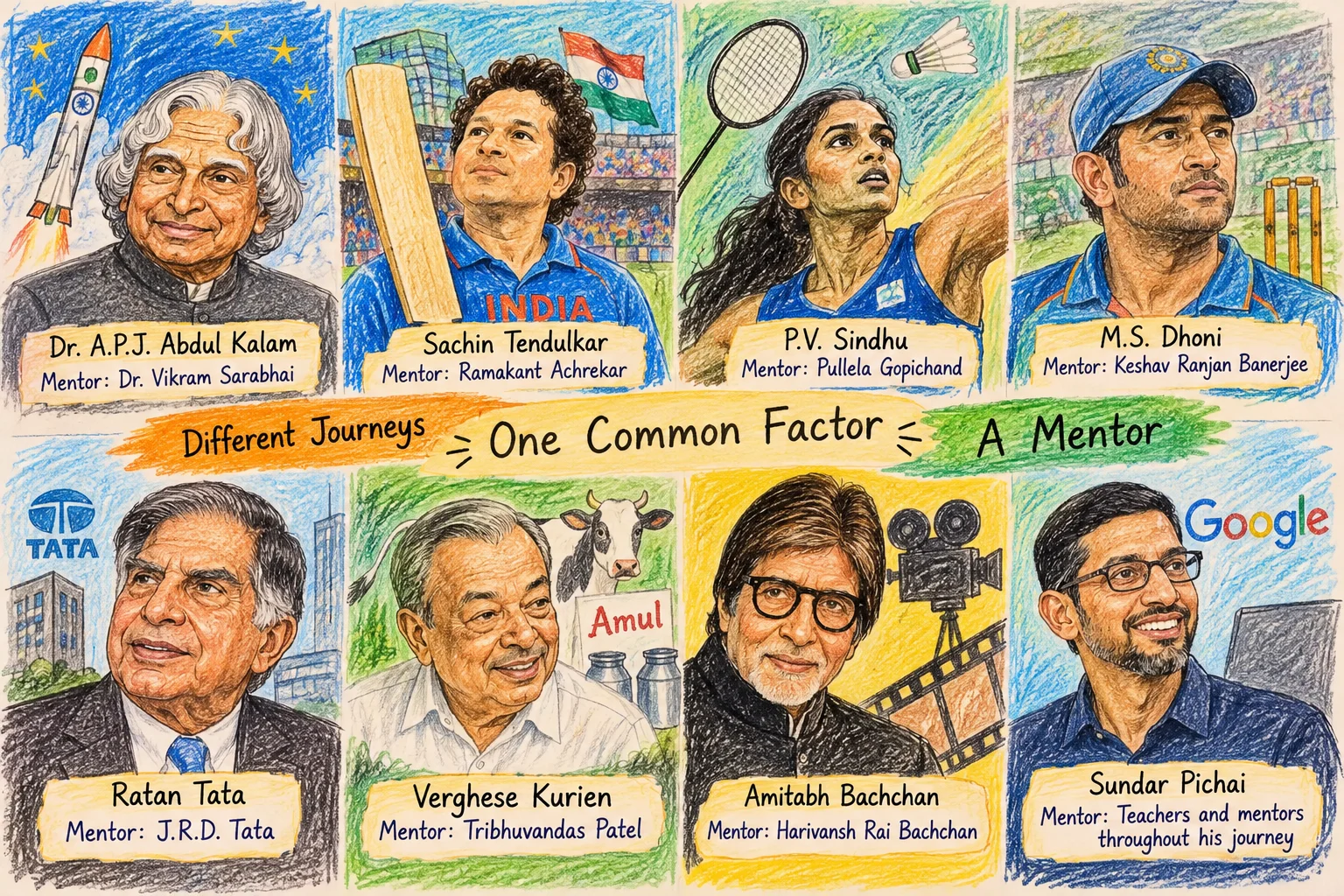
Influential Indian | Mentor / Guide |
Dr. A.P.J. Abdul Kalam | Dr. Vikram Sarabhai |
Sachin Tendulkar | Ramakant Achrekar |
P.V. Sindhu | Pullela Gopichand |
M.S. Dhoni | Keshav Ranjan Banerjee |
Ratan Tata | J.R.D. Tata |
Verghese Kurien | Tribhuvandas Patel |
Amitabh Bachchan | Harivansh Rai Bachchan |
Sundar Pichai | Teachers and mentors throughout his journey |
Different professions.
Different generations.
Different backgrounds.
Yet there is one remarkable pattern connecting all of them.
They had a mentor who guided them at the right stage of life.
Success Rarely Happens Alone
When we celebrate successful people, we usually focus on the destination.
The awards.
The companies.
The records.
The achievements.
What we don't always see are the people quietly standing behind those achievements.
Someone who noticed potential.
Someone who believed before anyone else did.
Someone who challenged comfort.
Someone who created opportunities.
Success is rarely a solo journey. It's often a guided one.
Let's look at a few stories.
1. Dr. A.P.J. Abdul Kalam and Dr. Vikram Sarabhai
Before Dr. A.P.J. Abdul Kalam became India's "Missile Man" and later the President of India, he was a young aerospace engineer trying to find his place.
Dr. Vikram Sarabhai, the father of India's space programme, recognized Kalam's potential and entrusted him with meaningful responsibilities in India's growing space mission.
Sarabhai didn't simply teach science.
He taught purpose.
He gave Kalam confidence that he could contribute to something larger than himself.
Lesson from this mentorship
Sometimes the greatest gift a mentor gives is belief before achievement.
2. Sachin Tendulkar and Ramakant Achrekar
Everyone remembers Sachin Tendulkar's centuries.
Few remember the man who made him practice for hours every single day.
Coach Ramakant Achrekar would place a one-rupee coin on the stumps during practice.
If Sachin survived the entire session without getting out, he earned the coin.
Years later, Sachin said those coins became some of his most treasured possessions.
The lesson wasn't about cricket.
It was about discipline.
Lesson from this mentorship
Talent opens the door.
Discipline keeps it open.
3. P.V. Sindhu and Pullela Gopichand
Olympic medals are won long before the tournament begins.
Pullela Gopichand created a training environment built around relentless discipline.
Early mornings.
Rigorous routines.
Continuous improvement.
Sindhu has often spoken about the sacrifices and consistency required throughout her career.
Lesson from this mentorship
A mentor pushes you beyond your comfort zone because they can see the version of you that doesn't exist yet.
4. M.S. Dhoni and Keshav Ranjan Banerjee
Before becoming one of India's most successful captains, Dhoni was a goalkeeper playing football.
His school coach, Keshav Ranjan Banerjee, noticed his reflexes and encouraged him to try wicketkeeping.
That small suggestion changed the course of Indian cricket history.
Lesson from this mentorship
Sometimes mentorship is simply seeing a possibility that you cannot see yourself.
5. Ratan Tata and J.R.D. Tata
J.R.D. Tata wasn't just Ratan Tata's predecessor.
He became one of his biggest influences.
From him, Ratan Tata learned:
Long-term thinking.
Ethical leadership.
Humility despite success.
Building institutions instead of chasing short-term gains.
Those values later became deeply associated with Tata's leadership style.
Lesson from this mentorship
A mentor shapes how you lead, not just what you achieve.
6. Verghese Kurien and Tribhuvandas Patel
Verghese Kurien didn't initially plan to transform India's dairy industry.
Tribhuvandas Patel believed Kurien could help farmers build something bigger than a dairy plant.
That partnership eventually led to the Amul cooperative movement and India's White Revolution.
Lesson from this mentorship
The right mentor doesn't always give answers.
Sometimes they give you a mission.
7. Amitabh Bachchan and Harivansh Rai Bachchan
Amitabh Bachchan often credits his father, celebrated poet Harivansh Rai Bachchan, for shaping his thinking.
His father's writings and life lessons taught him resilience through failure and humility through success.
One famous lesson remained with him throughout life:
Keep moving forward, even when life becomes difficult.
Lesson from this mentorship
Mentors don't only build careers.
They build character.
8. Sundar Pichai and the Mentors Along the Journey
Sundar Pichai's journey—from Chennai to IIT Kharagpur, Stanford, and eventually Google—was influenced by teachers, professors, managers, and leaders who helped him grow.
Rather than one mentor, he benefited from mentorship at different stages.
Academic mentors.
Professional mentors.
Leadership mentors.
Lesson from this mentorship
Mentorship evolves as your career evolves.
You don't need one mentor for life.
You need the right mentor for the next stage.
What These 8 Stories Teach Us
Although these stories are different, they share five common lessons.
Lesson | Why It Matters |
Belief | A mentor sees potential before the world does. |
Discipline | Growth comes from consistent habits, not motivation alone. |
Perspective | Mentors help you avoid mistakes they've already made. |
Opportunity | Many careers change because someone opens the right door. |
Accountability | Real mentors tell you what you need to hear—not just what you want to hear. |
Books Give Knowledge. AI Gives Answers. Mentors Give Direction.
This is probably the biggest lesson in today's world.
We have unlimited information.
Want to learn AI?
Thousands of YouTube videos.
Want to learn SAP?
Hundreds of certifications.
Want career advice?
Millions of LinkedIn posts.
Information has become abundant.
Direction is still scarce.
A mentor brings something AI and the internet cannot fully replace.
AI Can Help You With | A Mentor Helps You With |
Finding learning resources. | Choosing which resource fits your career. |
Explaining concepts. | Explaining trade-offs from experience. |
Generating answers. | Asking the right questions. |
Creating study plans. | Keeping you accountable. |
Sharing information. | Sharing judgment built through real experience. |
A mentor doesn't simply ask:
"What do you want to learn?"
A mentor asks:
"Where do you want your career to be five years from now?"
That's a completely different conversation.
Why So Many Talented People Still Feel Lost
Every year, millions of students graduate from colleges across India.
Millions more enroll in online courses hoping to improve their careers.
Yet many still struggle with questions like:
Which skill should I learn?
Which certification is worth the money?
Should I switch careers?
Should I pursue AI, Data Science, SAP, Cloud, or Product Management?
Am I learning because it's trending—or because it fits my goals?
The challenge isn't the lack of options.
It's too many options.
Many talented people lose months—or even years—following the wrong path.
The difference is often not intelligence.
It's guidance.
Think Back to When You Were 22...
Pause for a moment.
Think back to when you were 22.
Would your career have been different if someone had told you:
Learn this skill before it becomes mainstream.
Don't chase every trend.
Focus on fundamentals first.
Take this opportunity.
Walk away from that one.
Most professionals answer yes.
One conversation at the right time can save years of confusion.
That is the true return on mentorship.
What Mentorship Means at Choice Dekho
At Choice Dekho, we believe comparison is only half the journey.
Choosing a course is important.
Choosing the right direction is even more important.
That's why we're starting the Choice Dekho Mentorship Series.
Our goal is simple:
Learn from professionals who've already walked the path.
Understand real career journeys—not just success stories.
Help students and working professionals make better learning and career decisions.
Build a community where experienced professionals mentor the next generation.
Because sometimes the most valuable investment isn't another course.
It's one conversation with the right mentor.
How to Find the Right Mentor (A Practical Framework)
If you're wondering where to start, use this simple framework.
1. Know what you need help with.
Don't look for a "perfect mentor."
Look for someone one or two stages ahead of you.
2. Ask specific questions.
Instead of:
"Can you mentor me?"
Ask:
"I'm planning a career in SAP IBP. Could I ask you three questions about getting started?"
3. Respect their time.
Come prepared.
Research first.
Ask thoughtful questions.
4. Apply the advice.
Nothing motivates mentors more than seeing progress.
5. Stay connected.
Mentorship is a relationship—not a one-time conversation.
Takeaways You Can Apply Today
Don't wait until you're struggling to find a mentor.
Choose mentors based on values and experience—not popularity.
Ask for guidance, not shortcuts.
Apply advice before asking for more advice.
Become a mentor once you've learned something worth sharing.
The best mentorship creates another mentor.
Final Thought
Every successful person has a story.
Behind many stories is someone who believed before success became visible.
A teacher.
A coach.
A leader.
A parent.
A mentor.
Maybe you've already had one.
Maybe you're still looking for one.
Or maybe it's your turn to become one.
Better career decisions create better lives. Better lives create better families. Better families create a better society.
That's the belief behind Choice Dekho.
Frequently Asked Questions (FAQ)
Why is mentorship important for career growth?
Mentorship provides personalized guidance, feedback, accountability, and career perspective that goes beyond books or online courses.
What's the difference between a mentor and a coach?
A mentor shares experience and long-term career guidance, while a coach typically focuses on improving specific skills or achieving defined goals.
Can AI replace mentors?
AI can explain concepts, generate learning plans, and answer questions. Mentors add context, judgment, lived experience, and accountability that AI cannot fully replace.
Who should have a mentor?
Students, fresh graduates, mid-career professionals, career switchers, entrepreneurs, and leaders can all benefit from mentorship at different stages of their journey.
How do I find the right mentor?
Start by identifying your career goal, connect with professionals a few steps ahead of you, ask thoughtful questions, and consistently apply their guidance.