Energy & Earth Sciences Basics
Fundamental principles and concepts
PurdueX: Groundwater Contamination
The Earth is blue for its oceans and green for its groundwater. Access to clean freshwater is essential yet human activities deteriorate water quality. This unit describes contaminant transport in aquifers.
radio_button_checkededX Subscription
₹10,634/yr
₹12,51015% OFF
Get this course and thousands more with a edX Subscription subscription.
radio_button_uncheckedIndividual Course
₹622500
Keep the course forever with lifetime access and receive a certificate.
TeamsBilled annually • 14-day free trial
₹28,072
EnterpriseFor organizations with 50+ learners
Custom Pricing
Why choose Essentials (Small Teams)?
verifiedGet this course for free with the Coursera Plus subscription.
✓ Compare courses before making a decision
Check Latest Price →Price may vary. Check latest price on provider site.
Course Insight
Designed for advanced/expert practitioners. Designed for experienced practitioners. We recommend having a solid grasp of Energy & Earth Sciences fundamentals before starting this specialization.
Advanced LevelCertification IncludedSelf-Paced LearningHands-On Learning
SKILLS TO
MASTER
Practical ApplicationTrending
Real-world project implementationBest Practices
Industry standard workflows and guidelinesCareers:Frontend Developer, Full Stack Developer, Web Engineer.
Quick Facts
Below sections are verified from last major sync. For real-time updates and today's latest lectures, Check official page here.
What You’ll Learn
- Explain the difference between diffusion and dispersion .
- Derive the diffusion equations from mass balance .
- Explain advective mass fluxes.
- Define the notion of representative elementary volume.
- Explain the difference between a differential equation and its solution.
- Select the appropriate method to estimate transport parameters.
- Compare and contrast the various methods of solution.
- Outline the principle of superposition and convolution.
- Calculate the velocity and dispersion coefficient from observations using the moments method.
- Contrast the behavior of conservative and reactive solutes.
- Explain linear and non-linear sorption.
- Define the notion of chemical equilibrium and reaction kinetics.
- Sketch the evolution of concentration vs time for a zero and first order reaction.
- Explain why Monod kinetics describe biological remediation better than first order models.
- Illustrate groundwater contamination for different scenarios.
- Model iron oxidation when contacting the atmosphere.
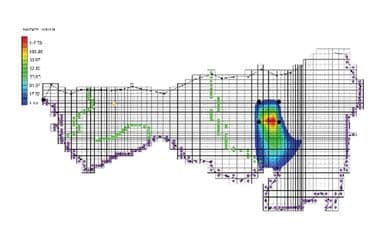
- Use a finite difference scheme to model a heterogeneous aquifer with a landfill and a particle tracking scheme to illustrate a leak. .
- Explain how wells operations can interfere with contaminant transport.
See side-by-side differences in what you’ll learn
Description
Groundwater is the water beneath the ground surface. It is a vast freshwater reservoir often overlooked because invisible, yet 1000 times greater than all lakes and rivers. The Earth is blue for its oceans, but green for the freshwater under our feet. Half of the world’s population rely on groundwater for drinking. Inadequate access to safe freshwater contributes to social, economic and political instability. Human activities can affect the quality of underground freshwater. Storage tanks and sceptic systems can leak, old landfills can seep, road salts can infiltrate the ground.
This course describes the principles of transport in aquifers so that engineers can predict and plan the safe extraction of groundwater for private and public use. Engineers design the treatment of contaminated groundwater in situ or above ground; they understand how to isolate and treat a plume of using the principles of transport processes in porous media. In the United States, the Safe Drinking Water Act directs the Environmental Protection Agency to establish maximum contaminant-level goals (MCLGs) and maximum contaminant levels (MCLs) for drinking water.
How do we know how safe well-water is? How do different contaminants move through aquifers? How do we model contaminant plumes from landfills or other sources?
In this course, we will cover the following topics:
1) The Advection Dispersion Equation: The fluxes of dissolved contaminants are dictated by the mixing of water in the porous media by dispersion and its relocation by advection. We derive and describe these processes both conceptually and mathematically.
2) Methods of Solution: We describe a number of methods to help solve the differential Advection Dispersion Equation. Analytical solutions can help with heuristics, but often more practical numerical methods such as particle tracking and finite differences can help understand the behavior in more complicated, heterogenous formations.
3) Issues with Dimensions (and Boundaries): Unlike streams and channels, aquifers cannot be modeled with one dimensional equation. We focus on two dimensional schemes that treat aquifers as plane from a top view.
4) Notions of Reactive transport: Aquifers process nutrients and other contaminants. The fate of a chemical may be complex but is often described as a simple upscaled process. We describe the assumptions tied to the bulk behavior.
5) Applications: In this last topic, we provide examples of landfill and well contamination and walk through an example of a MODFLOW model
See how this course compares with alternatives
FAQs
Top Alternatives
Highly-rated courses worth your attention